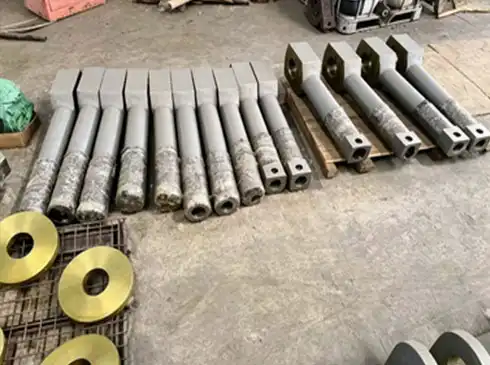
How Long Is the Service Life of Blast Furnace Hot Stove Refractory Lining?
How Long Is the Service Life of Blast Furnace Hot Stove Refractory Lining?
Understanding Refractory Lining and Its Role in Blast Furnace Hot Stoves
- Understanding Refractory Lining and Its Role in Blast Furnace Hot Stoves
- Key Factors That Determine How Long the Lining Lasts
- SMEC Refractory Lining: Why Service Life Exceeds Industry Averages
- Maintenance and Replacement Strategies to Maximize Lining Life
- Procurement Considerations for Hot Stove Refractory Linings
- Conclusion
- FAQ
- Partner with SMEC for Proven Blast Furnace Hot Stove Refractory Lining Solutions
- References
The refractory lining for blast furnace hot stove systems is one of the most durability-critical components in ironmaking infrastructure. Based on material grade, operational intensity, and installation precision, a well-engineered ceramic insulation lining can serve reliably for 15 to 25 years under standard conditions. Lower-grade conventional linings, by contrast, typically show widespread deterioration within 3 to 5 years and often require full-scale renewal by year 6 to 8. Understanding this performance gap is essential for procurement professionals who need to minimize unplanned downtime and optimize total lifecycle cost.

Understanding Refractory Lining and Its Role in Blast Furnace Hot Stoves
What the Lining Actually Does Inside the Stove?
The hot blast stove works by heating regenerative checkerwork to over 1,200°C and then transferring that heat to cold blast air before it goes into the blast furnace. This is possible because of the refractory lining for blast furnace hot stove systems that line the interior. It keeps the steel shell from getting damaged by heat, keeps heat from escaping through the stove wall, and keeps the structure strong after tens of thousands of heat-cool cycles.
The inner material has to work hard in three different areas inside the stove. In the dome or crown zone, which can get as hot as 1,550°C, silica bricks work very well because they keep their shape well and are very resistant to breaking when they are loaded. Dense alumina or mullite-based refractories are needed in the combustion chamber to stop flames from getting in and for the temperature to change quickly. Fireclay or low-creep high-alumina bricks are used in the checkerwork zone to handle both the mechanical load and the chemical attack of blast furnace gas.
Each material zone was designed to do a certain job. Material that doesn't belong in the right zone is one of the most common and expensive mistakes people make when they buy things.
Key Factors That Determine How Long the Lining Lasts
Thermal Shock, Chemical Erosion, and Installation Precision
Over time, three main things wear down the refractory lining for blast furnace hot stove units: temperature cycle stress, alkali vapor corrosion, and bad fitting work. Rapid changes in temperature cause tiny cracks that get bigger and bigger until they break. A process sometimes called "glassing" happens when alkali fumes from blast furnace gas mix with refractory minerals to make low-melting-point phases. This weakens the brick structure and blocks checkerwork pathways. High-speed gas flow adds to the corrosion in the lower regenerator zone by wearing away at the material.
The quality of the installation is also very important. Checker bricks should have a tolerance of no more than ±0.5mm in their dimensions to make sure air flow and heat exchange work well. To get the right expansion joints, you need to know the material's measured thermal expansion coefficient. If you get this wrong, the shell will deform and the structure will become unstable. A controlled heating-up curve during commissioning keeps things from going horribly wrong early on, especially in the 200–300°C phase transition range for silica bricks.
The technical paperwork should include information about the material's thickness, bulk density (which is usually between 2.4 and 2.6 g/cm³ for alumina-type bricks), and creep rate (which should be less than 0.2% after 50 hours at 1,550°C). These should all be checked by the buying team before the goods are shipped.
SMEC Refractory Lining: Why Service Life Exceeds Industry Averages
Engineered for Long-Cycle, Low-Fault Operation
China Silian Machinery and Engineering Corporation (SMEC) has improved both the formulation and manufacturing process of its refractory lining for blast furnace hot stove products. Under normal conditions, SMEC linings show stable service performance for more than 15 years, which is a standard that far beats other options on the market by a large margin.
A mix of high-purity raw materials and composite additive systems gives the product an edge in performance. This is what makes SMEC linings different in terms of structure and process:
- High-purity refractory base materials combined with composite additives produce a dense, high-strength microstructure that can withstand thermal shock, flue gas corrosion, and erosive wear all at the same time. It can go through tens of thousands of thermal cycles without cracking, spalling, pulverizing, or ablation.
- High-temperature sintering and pressure densification during production eliminate internal weak spots and microvoids, delivering a monolithic lining structure that maintains insulation integrity throughout its full service period without localized collapse.
- Superior resistance to alkali attack and checkerwork clogging ensures that blast furnace gas contamination does not accelerate structural degradation, keeping flow passages open and heat exchange efficiency constant over years of continuous operation.
Together, these features deal with the most common types of failure that make stoves less available. SMEC products greatly lower the number of overhauls needed and the amount of production lost during planned and unplanned shutdowns, compared to traditional linings that need major repairs every 6 to 8 years.
Maintenance and Replacement Strategies to Maximize Lining Life
Inspection Protocols That Add Years to Service Life
Systematic care is good for even the best refractory lining for blast furnace hot stove installations. Ultrasonic non-destructive testing (NDT) and thermal imaging scans can find internal laminations, cracks that are starting to show, and places where heat is escaping normally before they get worse and cause the structure to fail. Finding wear patterns early on lets you replace a few bricks instead of doing a full relining project, which saves money and is important for large-scale operations.
There should be a written inspection plan for condition tracking that is linked to the number of working hours and thermal cycle counts. Cracks in the surface that can be seen, strange readings on the shell's temperature, changes in the temperature of the hot blast that can be measured, and strange pressure drops in the regenerator are all important warning signs. If any of these signs show up, you need to act quickly to protect both the lining and the operation of the blast furnace below.
Custom lining designs—where the type of material used, the thickness of the layers, and the way the joints are set up are all customized to fit the gas composition, blast temperature, and cycling pattern of a plant—last much longer than off-the-shelf options. Professional construction teams that have done hot stove relining before also make sure that the performance that was planned actually happens.
Procurement Considerations for Hot Stove Refractory Linings
When looking for a refractory lining for blast furnace hot stove job, you should look at more than just the unit price. Manufacturers who can be trusted show that they follow the rules for ISO 1109 classification and ASTM C210 reheat change. It is necessary to check the Cold Crushing Strength (CCS) test results, the alkali resistance tests according to ASTM C454, and the creep resistance under load.
It's helpful for procurement professionals to send out detailed RFQs that include information about the materials used, any required test documentation, delivery dates, and any size or shape tolerances. When you look at projected service life, overhaul regularity, and production loss during relining, the total cost of ownership always favors higher-performance materials over the cheapest ones. Using providers who offer help with design, installation, and service after the system is up and running lowers buying risk even more.

Conclusion
Sometimes, a refractory lining for blast furnace hot stove will only last three years, but if it's made well and put by a professional, it can last 25 years or more. Where an installation falls in that range is based on the materials used, the design of the zone, how well they are installed, and how often they are checked for damage. SMEC's lining products have service lives of more than 15 years under normal working conditions. This is because they were developed through careful formulation and process optimization. These products help steel mills, coking plants, and integrated metallurgical operations save money on maintenance costs and production downtime.
FAQ
How often does a blast furnace hot stove refractory lining need to be replaced?
Replacement times are very different. Every 3 to 7 years, standard-grade linings need to be fully relined or need major repairs. SMEC makes high-performance engineered refractory lining for blast furnace hot stove systems that can work reliably for 15 years or more under normal working conditions, substantially reducing overhaul frequency and associated production losses.
What are the early signs that a hot stove lining needs attention?
If you look inside the shell and see cracks or erosion on the surface, if the hot blast outlet temperature drops for no apparent reason, or if there are bigger pressure differences across the checkerwork, these are all signs that the lining needs to be looked at more closely or fixed specifically.
Do custom refractory solutions genuinely extend service life?
Yes. The lining works much better than generic goods when the material grade, layer structure, and joint design are all customized to the plant's specific gas chemistry, blast temperature range, and cycling frequency. Mismatches between the material and the situation that cause early decline can be fixed with custom solutions.
What certifications and tests should procurement teams require?
As part of the specifications, each package should have to meet the requirements for ISO 1109 classification, ASTM C210 reheat change data, Cold Crushing Strength (CCS) results, alkali resistance test reports according to ASTM C454, and ultrasound NDT certification.
Partner with SMEC for Proven Blast Furnace Hot Stove Refractory Lining Solutions
SMEC has decades of experience making specialized products, and they use that experience on every refractory lining for blast furnace hot stove project. With zone-specific design, high-purity raw materials, and pressure densification processes, our goods have service lives of more than 15 years with very low fault rates. We are an authorized provider of refractory lining for blast furnace hot stoves, and we help procurement teams by giving them full technical documents, custom design services, and quick support after the sale. Reach our engineering team at project@smec.cc or visit smecltd.com to discuss your project specifications.
References
1. Ironmaking and Steelmaking: Processes, Products and Applications — The Institute of Materials, Minerals and Mining, 2014.
2. Refractories for Iron and Steel Industry — The American Ceramic Society Bulletin, 2018.
3. ASTM C210: Standard Test Method for Reheat Change of Insulating Firebrick — ASTM International, 2022.
4. ISO 1109: Shaped Refractory Products — Classification — International Organization for Standardization, 2020.
5. High-Temperature Corrosion of Refractories in Blast Furnace Hot Stoves — Journal of the European Ceramic Society, 2019.
6. Thermal Cycling Degradation Mechanisms in Alumina-Silica Refractories — Ceramics International, 2021.
Free consultation & volume discounts available
SEMC focuses on the entire metallurgical process—from coking, ironmaking, and steelmaking to continuous casting and rolling. Whether you face challenges related to equipment upgrades, energy efficiency optimization, or overall process transformation, please fill in the following information. Our technical team will provide you with tailor-made high-end equipment upgrade solutions and professional EPC design services to help your project be implemented efficiently.
Recommended Blog
_1788773636949.webp)
Can Temperature Sensors Fit Different Types of Blast Furnace Cooling Staves?
Why Does the Blast Furnace Tuyere Area Need Corrosion Protection?
How Fast and Accurate Is the Temperature Sensor for Cooling Stave Monitoring?
How Slag Granulation Equipment Reduces Environmental Impact
Can Blast Furnace Tuyere Camera Work Under Extreme High Temperature Conditions?
What Are the Advantages of Blast Furnace Self-Standing Furnace Shell Equipment?