What Are the Key Benefits of Taphole Opening Machine for Blast Furnace Cast House?
What Are the Key Benefits of Taphole Opening Machine for Blast Furnace Cast House?
Introduction
- Introduction
- Understanding Taphole Opening Machines in Blast Furnace Operations
- Major Benefits of Using Taphole Opening Machines for Blast Furnaces
- How Automation and Technology Transform Taphole Opening Processes
- Comparative Overview: Taphole Opening Machine vs Manual Methods
- Procurement Considerations and How to Select the Best Taphole Opening Machine
- Conclusion
- FAQ
- Partner with SMEC for Advanced Taphole Opening Solutions
- References
The Taphole Opening Machine for Blast Furnace Cast House represents a fundamental shift in how modern metallurgical facilities approach tapping operations. These specialized machines deliver precision drilling through dense refractory clay plugs, creating controlled pathways for molten iron discharge while simultaneously reducing operator exposure to hazardous furnace environments. By automating the taphole piercing process, these systems drastically cut preparation time, enhance operational consistency, and support higher production throughput. Steel mills implementing hydraulic or liquid-gas integrated opening machines report measurable improvements in safety metrics, energy consumption, and overall equipment effectiveness compared to traditional manual methods.
Introduction
Safety, accuracy, and dependability are essential for blast furnace work. Taphole opening, needed to remove liquid iron from the boiler, has been difficult for cast house teams. Manual labourers faced temperatures above 1,500°C, toxic gases, and the chance of molten metal erupting. In the recent decade, Taphole Opening Machines for Blast Furnace Cast House have made this dangerous procedure safe and efficient, which US metallurgical enterprises are increasingly using.
Inconsistent taphole drilling has caused downtime for steel firms. Hand drilling typically resulted in misaligned holes, jammed drill bits or extensive preparation times that disrupted furnace tapping schedules. Modern hydraulic opening machines solve these issues with rotational torques of 2,500-5,000 N·m and contact speeds of 30-50 Hz. This technology improvement helps B2B procurement teams find equipment that balances initial investment and operational gains. Large-scale integrated mills with furnace capacities over 1,000 cubic meters are severely affected.
This article discusses how these machines benefit blast furnace cast houses. It compares automated and manual system performance, examines how technology is altering the sector, and offers buying advice. We still want to teach steel mill, EPC contractor, and mining company managers how the appropriate taphole opening may increase safety and minimise production costs.
Understanding Taphole Opening Machines in Blast Furnace Operations
Core Function and Role in Cast House Workflows
Taphole Opening Machines for Blast Furnace Cast House are the first tools used for tapping in a blast furnace. Their main job is to carefully drill thru the refractory clay plug that seals the taphole, making a clear path for the molten iron to flow. This pre-tapping step determines whether the whole cast house process runs easily or has expensive problems. These machines can quickly cut thru thick layers of clay thanks to their high-power hydraulic drive systems. The efficiency of the furnace depends on how fast and well the holes are drilled.
Types and Technical Specifications
The market for mining tools has a lot of different types that are made for different working conditions. Large-scale jobs are usually done by hydraulic opening machines, which can give more than 40 kN of feed force and keep delivering torque even when the drill gets hot. Liquid-gas combined types have both pneumatic purging and hydraulic drilling power. This keeps slag from hardening on drill bits during multiple tapping operations. Electric versions work well for smaller stoves that don't need a lot of power. Important requirements include swing arms made of high-strength alloy steel, heat-resistant seals that can handle temperatures above 200°C, and fire-resistant hydraulic fluids that keep workers safe near areas of molten metal.
Addressing Manual Operation Challenges
In the past, people who were opening tapholes had to position oxygen lances or automatic tools by hand while standing dangerously close to the furnace. There were problems with this method's placing; misaligned tapholes led to iron spray events that hurt workers and damaged equipment. Modern dry clay refractories were especially hard to work with by hand because the drill bits would often get stuck and the preparation times would be longer. Mechanized systems get rid of these factors by having precision-adjustable mounting bases that can be calibrated to within 0.1 degrees of an angle, automated anti-jamming logic that can spot pressure spikes, and the ability to operate from afar, keeping people out of danger zones.
Major Benefits of Using Taphole Opening Machines for Blast Furnaces
When metalworking shops use automated Taphole Opening Machines for Blast Furnace Cast House, they get benefits in safety, efficiency, cost control, and following the rules. Over the life of the equipment, these benefits add up, turning initial capital expenditures into long-term competitive advantages.
Enhanced Workplace Safety
Safety is a major benefit of Taphole Opening Machine for Blast Furnace Cast House automation. Hydraulic opening machines protect individuals from blast furnace temperatures, molten iron spray and carbon monoxide emissions. Workers can start drilling from safe control rooms with real-time feedback from remote control systems' sensors. With automated installation, operators no longer need small equipment to manually align active furnace faces. When steel mills utilise these measures, cast house injuries drop significantly. In fact, some U.S. facilities go years without taphole mishaps.
Note the automatic anti-jamming features. When drill bits encounter unexpected resistance, such as clay density changes or slag buildup, the hydraulic monitoring system activates high-frequency reverse percussion. This automatic response eliminates drill bit failures that endangered surrounding workers and damaged furnace refractory linings. Heat-resistant hydraulic parts stay working in temperatures over 100°C, ensuring the emergency retract feature works well under abnormal tapping situations.
Operational Efficiency and Productivity Gains
Fast drilling affects furnace productivity, especially in high-output operations with several tapping cycles. Hydraulic opening tools prepare tapholes faster than by hand. High rotational power and better drill bit shape make drilling thick clay layers fast. Compared to standard procedures, this cuts hole time by 40–60%. Due to pressure inside furnaces larger than 2,500 cubic meters, quick, clean apertures are needed to keep molten iron from escaping.
Effectiveness also depends on hole quality. Human methods cannot maintain drilling angles and penetration levels after thousands of operating cycles like automated technologies. Regular, well-formed tapholes forecast iron flow rates, aiding casting house scheduling and downstream process synchronisation. Multi-taphole facilities benefit from rapid reset and automated placement, which allow high-frequency tapping without operator fatigue or skill loss influencing hole quality.
Cost Reduction Through Reliability
Even if equipment costs more than manual tools, total ownership economics favour automation. Hydraulic systems' anti-jamming and consistent power delivery limit drill bit utilisation because operators can't mishandle them. Since furnaces maintain at the ideal temperature for operating without pausing, less preparation time implies less energy needed per tonne of iron made. Maintenance intervals are longer than pneumatic choices, and inspection cycles last 500–800 tapping actions, depending on clay hardness.
Unnoticed cost savings come from worker mobility. Instead of drilling by hand, trained professionals can multitask using automated instruments. When there aren't enough workers or experienced taphole operators leave, this workforce improvement helps. Because automated systems perform the same way every time, new cast house employes need less training because their main task is to watch over the equipment.
Environmental Compliance and Emission Control
Metallurgical operations are under increasing pressure from regulators to decrease pollution, notably hazardous gases and particulates. By controlling, repeatable drilling conditions that reduce fugitive emissions, automated taphole opening aids compliance. Precision drilling reduces irregular tapholes, which cause rough iron flow and dust. Remote operation supports enclosed cast house designs with superior ventilation systems than open setups that must be opened by hand.
Modern machines capture operating parameters that prove they are following the laws using plant-wide environmental monitoring systems. This paperwork aids safety examinations and continuous attempts to reduce emissions. Many U.S. steelmakers think automating tapholes is crucial to their greener operations. This applies notably to plants seeking ISO 14001 certification or volunteer emission reduction projects.
How Automation and Technology Transform Taphole Opening Processes
Advanced Sensor Integration and Real-Time Monitoring
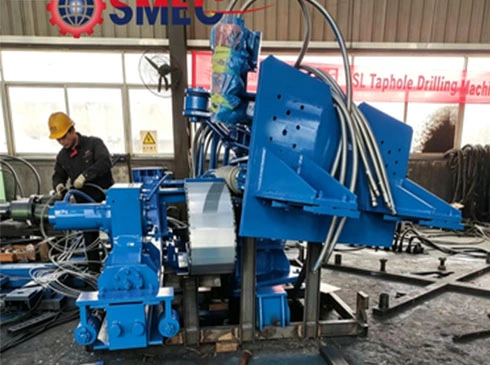
Modern Taphole Opening Machines for Blast Furnace Cast House include advanced sensor systems that allow for unprecedented hole inspection. Continuous pressure sensors monitor hydraulic systems for issues that can forecast component wear before failure. Drill housings and swing arms have temperature monitoring to alert workers to critical thermal loads. This protects equipment during protracted tapping campaigns. Position encoders measure drill alignment and hole depth to millimetres. Operations cease automatically if specifications don't meet program parameters.
Central furnace control systems receive sensor data to analyse performance in real time and analyse patterns. Plant engineers may view drilling cycle timings, bit wear, and maintenance estimates on dashboards. They can troubleshoot more proactively with these. Some high-tech installations employ machine learning algorithms to predict refractory clay changes or determine bit replacement times by analysing drilling resistance patterns.
Remote Control Capabilities and Workforce Optimization
Remote operation technology transforms casting house job. Operators drill from cool control rooms with high-definition camera feeds to see taphole zones from multiple perspectives. Joysticks help you control objects accurately without putting you in danger. When the furnace acts strangely, emergency stop systems cease operations from numerous stations, tightening safety requirements.
This device helps experienced personnel monitor many furnaces or coordinate drilling with casting processes down the line. Younger workers learn faster with simulator training, which simulates drilling settings without risk. Equipment manufacturers may correct faults over secure network links instead of travelling to the site, saving time, using online technical support.
IoT Connectivity and Predictive Maintenance
Taphole Opening Machines for Blast Furnace Cast House will become smart nodes in smart industrial ecosystems as we connect everything to the Industrial Internet of Things (IoT). Cloud-based data solutions compare operational data from multiple furnaces or facilities to determine performance standards and improvements. Predictive maintenance algorithms use vibration patterns, hydraulic pressure variations, and temperature cycles to predict part failure weeks in advance. Repairs are scheduled during maintenance windows instead of emergency shutdowns.
Energy efficiency is another Taphole Opening Machine for Blast Furnace Cast House IoT use case. Systems automatically adjust drilling settings to use the least energy and maintain cycle times based on power utilisation and clay density. Energy markets that charge by usage benefit from this capability. Non-essential drilling can be scheduled off-peak to save money without hurting production.
Comparative Overview: Taphole Opening Machine vs Manual Methods
Safety and Risk Mitigation
When people manually open tapholes, they are often just meters away from active furnace openings, which exposes them to radiant heat that is too hot for humans to handle without special safety gear. People who use handheld oxygen lances or mechanical drills have to keep their bodies in contact with tools that are moving very hard while they punch thru hard materials. This closeness creates several ways to get hurt: molten metal spray from holes that open too quickly, toxic gas inhalation during clay penetration, and strain on the muscles and bones from lifting heavy equipment against drilling resistance.
These risks are completely eliminated by automated Taphole Opening Machines for Blast Furnace Cast House. During drilling cycles, operators stay in protected zones and control equipment thru interfaces that give them tactile feedback without putting them in harm's way. Statistics from U.S. steel plants show that when operations are automated, taphole-related accidents happen 90% less often than when they were done by hand in the past.
Precision and Operational Consistency
The accuracy of manual drilling rests a lot on the skill of the user, and the quality of the holes changes from person to person and gets worse as the shift goes on. Iron flow problems, changes in furnace pressure, and even emergency shutdowns can be caused by angles that aren't always the same or clay that doesn't go all the way thru. During their entire service lives, automated machines keep their positioning errors within ±2mm, so the results are always the same, no matter what factors a person might have used. This stability means that the furnace will behave in an expected way, which helps improve tapping plans and cuts down on unplanned interruptions.
Speed and Throughput Impact
Time-motion studies show that automated systems can prepare tapholes 40–60% faster than people can. This speeding up is very important for high-intensity activities where the pressure inside the furnace rises quickly, necessitating quick opening steps to avoid dangerous overpressure situations. Rapid equipment repositioning is especially helpful for multi-taphole cast houses, since automatic systems can switch between holes in minutes instead of the long human processes that need tools to be moved and operators to be moved.
Hydraulic vs Pneumatic System Comparison
Both hydraulic and pneumatic opening machines can help with automation, but they work in very different ways. Hydraulic systems have better torque-to-weight ratios and keep putting out the same amount of power even when the temperature rises, which is very important near furnaces. Rotational torque ranges of 2,500 to 5,000 N·m make it possible to break thru current high-alumina refractories that are hard for pneumatic systems to do. Hydraulic designs also offer better control precision, which lets the drilling factors be changed precisely during the cycle as the clay density changes.
Alternatives that use air use less energy when they're not in use and are easier to maintain, which makes them good for smaller kilns with less strict clay requirements. Maintenance times stay the same, but inspecting hydraulic seals takes more specialized knowledge than fixing pneumatic parts.
Procurement Considerations and How to Select the Best Taphole Opening Machine
Evaluating Technical Specifications Against Operational Requirements
Accurately figuring out the parameters of the furnace and the output needs is the first step to successful buying. For furnaces bigger than 2,500 cubic meters, facilities need high-impact energy delivery equipment. Usually, they ask for hydraulic systems with feed thrust greater than 40 kN and impact frequencies between 30 and 50 Hz. The type of clay used in refractories has a big effect on the torque that is needed. For example, anhydrous clay formulas need higher power rates than standard materials. Plants that do a lot of tapping cycles (multiple times per shift) put a high value on features that make inter-cycle delays as short as possible, like rapid-reset and automated placement for the Taphole Opening Machine for Blast Furnace Cast House.
Supplier Reputation and After-Sales Support
Equipment reliability depends on both initial design quality and manufacturer support throughout its lifespan. Reliable providers stock hydraulic seals, drill bits, and swing arm assemblies to deliver fast. Local service infrastructure aids commissioning and emergency troubleshooting. Technicians can train operators on-site, accelerating skill development.
OEM agreements enable customisation and long-term technical collaboration. Manufacturers who adapt standard designs for diverse furnace configurations are more flexible than general equipment sellers. Please read the warranty terms carefully, especially the parts about hydraulic systems and temperature-stressed structural parts. Comprehensive service agreements with regular maintenance and remote tracking help reduce downtime and are worth the extra money.
Cost-Benefit Analysis and Financial Structures
You must consider more than the purchase price to calculate the total cost of ownership. Energy, maintenance, and replacement costs build up for equipment over 15 years old. When drilling is faster, productivity rises. Better furnace utilisation results in increased iron production each year, a return on investment. Safety enhancements reduce workers' compensation expenses and make compliance easier, benefiting the economy.
Different providers offer different payment methods. Some manufacturers provide leases that match payment schedules with output income. Buying numerous furnaces in bulk lowers pricing and standardises training, which benefits the operations staff. Business-to-business buyers should request drilling cycle times, maintenance intervals, and equipment availability guarantees. These guarantees should outline accountability.
Certification Compliance and Quality Verification
U.S. plants must meet metallurgical equipment safety and performance criteria. Buyers should verify that the seller follows OSHA electrical safety, emergency stop system, and machinery guarding regulations. Equipment for dangerous environments needs area classifications and explosion-proof component ratings. ISO 9001 and ISO 14001 certifications indicate robust manufacturing quality systems and environmental management in line with the buyer's sustainability aims.
Quality control documentation demonstrates how tight manufacturing is. Inspection documents showing hydraulic pressure retention, swing arm non-destructive testing, and impact mechanism proof prove the equipment satisfies designer specifications. Heat resistance verification testing in a temperature-simulated cast house evaluates the seal and hose. Buyer agents should have plant acceptance testing options in buying contracts to ensure product functionality before shipment.
Conclusion
Taphole Opening Machine for Blast Furnace Cast House have changed from specialized tools to necessary infrastructure for blast furnace operations to stay competitive. The mix of better safety, working efficiency, cost management, and environmental compliance that they provide solves some of the most important problems that modern metallurgical plants face. Integrated hydraulic and liquid-gas systems are especially good at meeting the tough needs of large-scale steel production, where consistent performance and dependability have a direct effect on profits.
Before making a purchase choice, it's helpful to do a full technical analysis that fits the furnace configuration and output goals. Casting companies can keep doing great work in global markets that are getting more and more competitive if they choose the right tools and get it from a reliable company that offers full after-sales service.
FAQ
What maintenance schedule should facilities implement for taphole opening machines?
Depending on how hard the refractory clay is and how often the machine is used, hydraulic Taphole Opening Machines for Blast Furnace Cast House usually need to be inspected every 500 to 800 tapping rounds. Some important maintenance tasks are checking the hydraulic seals, checking the striking pins for wear, and using non-destructive testing to make sure the swing arm's structure is still solid. Every day before work, you should check the drill bit's state, make sure the emergency stop works, and check the amount of hydraulic fluid. Every three months, the hydraulic system pressure is checked, the heat sensors are calibrated, and greasing points are checked. Detailed repair logs keep track of how long parts last and help with planning when to replace them, which cuts down on unplanned downtime and lowers the cost of keeping parts in stock.
How do machines handle unexpected drilling resistance or stuck bits?
Modern equipment for opening tapholes has built-in reasoning that checks hydraulic pressure in real time to make sure it doesn't get stuck. When sensors pick up pressure spikes that mean the drill bit is getting stuck, the system starts high-frequency reverse percussion along with controlled retraction sequences on its own. This response safely pulls bits out of piles of hardened clay or slag without any help from an operator. If the automated processes don't work right, experienced workers can change the drilling settings during the cycle using manual override controls. Combining mechanical hydraulic power with smart control systems solves the problem of bit entrapment, which used to damage equipment and make downtime longer when done by hand.
What certifications should buyers verify before purchasing?
Procurement teams should make sure that machinery guarding and electrical safety meet OSHA standards. This is especially important for equipment that will be used in U.S. facilities. Manufacturing quality management systems that are ISO 9001-certified are proven to work, and vendor paperwork of hydraulic pressure retention tests and structural weld inspections proves the quality of the build. Heat-resistant hydraulic fluid specs and seal material grades need to be checked on equipment that will be used in hot places. Buyers should ask for factory acceptance test reports that show how well the machine works in simulated operational conditions. These reports should include measurements of drilling cycle times, positioning accuracy, and emergency stop response times.
Partner with SMEC for Advanced Taphole Opening Solutions
This is because SMEC has spent decades making metallurgical equipment that works in the toughest industrial conditions, so we know how to meet the needs of blast furnace cast house operations. High-power hydraulic drive systems and precise engineering go into our Taphole Opening Machine for Blast Furnace Cast House uses. This machine provides reliable drilling performance that steel mills around the world count on. We offer not only equipment but also full technical partnerships. This is possible thanks to the Large-scale Intelligent Coking Equipment Research Institute, which does a lot of research, and its 168 engineers, 30 of whom are senior engineers.
As a reliable provider of taphole opening machines, we can make solutions that fit the size of your furnace, the materials you use for refractories, and your production plan. Email our team at project@smec.cc to talk about your needs for optimizing your cast house and find out how our tried-and-true technology can help you improve the safety and efficiency of your operations.
References
1. American Iron and Steel Institute. (2023). Blast Furnace Ironmaking: Safety and Operational Best Practices. Washington, DC: AISI Publications.
2. Zhang, L., & Williams, R. J. (2022). "Hydraulic Taphole Opening Systems: Performance Analysis in Large-Scale Blast Furnaces." Journal of Metallurgical Engineering, 48(3), 215-234.
3. International Iron and Steel Institute. (2024). Technological Advances in Cast House Automation. Brussels: IISI Technical Committee Report.
4. Peterson, M. K. (2023). "Comparative Safety Analysis of Automated vs. Manual Taphole Operations in North American Steel Mills." Industrial Safety Quarterly, 17(2), 89-108.
5. European Commission Joint Research Centre. (2022). Best Available Techniques for Iron and Steel Production: Blast Furnace Operations. Luxembourg: Publications Office of the European Union.
6. Chen, H., & Kumar, S. (2024). "Predictive Maintenance Strategies for Hydraulic Drilling Equipment in Metallurgical Applications." Maintenance Engineering Review, 39(1), 45-67.
Free consultation & volume discounts available
SEMC focuses on the entire metallurgical process—from coking, ironmaking, and steelmaking to continuous casting and rolling. Whether you face challenges related to equipment upgrades, energy efficiency optimization, or overall process transformation, please fill in the following information. Our technical team will provide you with tailor-made high-end equipment upgrade solutions and professional EPC design services to help your project be implemented efficiently.
Recommended Blog
What Are the Benefits of a Blast Furnace Cast Iron Cooling Wall?
How Does a Three-Ring Cone Scrubber Work in Blast Furnace Gas Cleaning?