How Does Taphole Opening Machine Perform in High Temperature and Dusty Conditions?
How Does Taphole Opening Machine Perform in High Temperature and Dusty Conditions?
Understanding the Challenges of High Temperature and Dusty Conditions in Cast Houses
- Understanding the Challenges of High Temperature and Dusty Conditions in Cast Houses
- Key Features and Technologies That Enhance Taphole Opening Machine Performance
- Comparing Manual and Automated Taphole Opening Machines in Extreme Conditions
- Maintenance Best Practices to Ensure Optimal Machine Performance
- Selecting the Right Taphole Opening Machine for Your Blast Furnace Cast House
- Conclusion
- FAQ
- Partner with SMEC for Your Taphole Opening Machine Needs
- References
A taphole opening machine for blast furnace cast house operations must endure some of the most punishing conditions in heavy industry—radiant heat exceeding 200°C near the casthouse floor, dense airborne particulate from coal dust and iron splash, and relentless mechanical vibration during every drilling cycle. When equipment fails under these stresses, the consequences reach far beyond a single repair bill. Unplanned downtime disrupts iron flow, damages taphole refractory linings, and threatens operator safety. Understanding exactly how modern machines handle these extremes is the foundation of every sound procurement decision.
Understanding the Challenges of High Temperature and Dusty Conditions in Cast Houses
Why Extreme Heat Degrades Equipment Faster Than Expected?
Long-term radiant heat speeds up thermal wear in structural welds and makes steel parts lose their shape. When standard elastomers are used to make hydraulic seals, they soften and lose their ability to hold pressure. Even small changes in temperature—ranging from room temperature to 200°C several times per shift—cause micro-cracks in casts that become structural failures after months of constant use. Thermal resilience is not just something to look for in a brochure for procurement engineers looking at cast house drilling equipment; it is an engineering requirement that can be measured.
How Dust and Particulate Contamination Compromise Mechanical Systems?
Very small particles are made in coking plants and integrated steel mills. These include sub-micron carbon dust, iron oxide fines, and refractory debris. These particles get into housings that aren't sealed, score the bores of hydraulic cylinders, and wear down rotating shafts. As soon as contamination gets past a seal, the damage gets worse quickly. Electrical control modules short-circuit, proportional valves get stuck, and the torque on the motor drops for no reason. The effect of heat and dust together doesn't just add up; it raises the risk of failure in ways that maintenance teams don't realize until the equipment is seriously damaged.
Key Features and Technologies That Enhance Taphole Opening Machine Performance
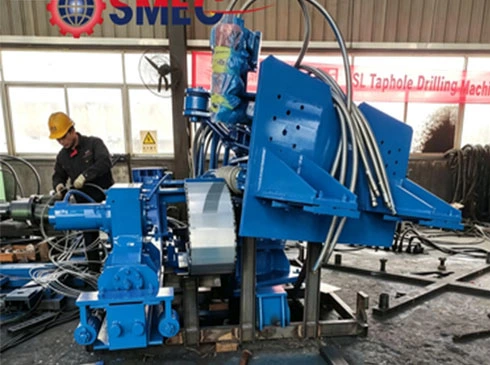
SMEC designs the taphole opening machine for blast furnace cast house environments using a layered security theory that sees heat, dust, and vibration as risks that affect each other rather than separate issues.
Here are the core protective technologies built into SMEC's blast furnace hydraulic opening machine:
- Heat-insulating structural casing: The machine body has a special high-temperature insulation and protecting structure that keeps the temperatures of the internal parts safe, even during long tapping cycles.
- Sealed and dust-proofed electrical and hydraulic circuits: Every core electrical module and hydraulic component goes through an airtight dust-sealing process. This stops coal dust, fine iron particles, and molten iron splash from getting into internal spaces. This stops systems from getting stuck, breaking down, and getting damaged before they should.
- High-temperature alloy drill rods and bits: Heat-resistant alloy steel is used to make the drill rods, drill bits, and the tip of the swing arm that come into direct contact with the taphole zone. They can be exposed to high temperatures for a long time without deforming, ablation, or faster wear.
- Vibration-optimized structural design: The machine frame and mounting system are built to handle the high-frequency percussion (usually 30 to 50 Hz impact cycles) during drilling as well as the normal vibrations of the casthouse floor. This keeps the machine stable in place and stops fasteners from coming loose over thousands of tapping cycles.
Together, these layers of protection do their job. Sealing by itself can't fix a structure that has been damaged by heat, and alloy drill parts by themselves can't keep hydraulics from getting contaminated. Together, they make it possible for the machine to work reliably around the clock in situations that would normally stop less carefully designed options from working.
Comparing Manual and Automated Taphole Opening Machines in Extreme Conditions
The Practical Limitations of Manual Systems in Harsh Environments
People who work with manual taphole opening machines are often close to radiant heat and iron splash, which is exactly where safety and hygiene rules try to keep people as far away from these things as possible. The drilling angle, feed rate, and entry depth change with each user and each shift, which makes operations less consistent. Furthermore, manual systems need to be inspected and cleaned more often in places with a lot of dust, which directly leads to higher labor costs and more unplanned downtime.
Why Automated Hydraulic Systems Outperform in Real-World Cast Houses?
Automated hydraulic opening machines provide uniform torque (usually between 2,500 and 5,000 N·m) and impact energy during every tapping cycle, even if the person is tired or the environment is different. Pressure monitoring with sensors finds unusual resistance and automatically activates anti-jamming logic to free a stuck drill bit without any user action. When high-frequency cycling needs to be reset quickly and precisely in multi-taphole cast houses, automated systems keep up levels of productivity that manual alternatives just can't match. Large blast furnaces (2,500 m³ and more) have recorded operating data that shows lower taphole refractory wear when controlled, repeatable opening forces are provided by automated tools.
Maintenance Best Practices to Ensure Optimal Machine Performance
In a high-heat, high-dust setting, structured care is needed instead of reactive repair to keep things running at their best. SMEC suggests that service intervals be set based on the number of tapping cycles instead of just the time on the calendar for a taphole opening machine for blast furnace cast house. For example, hydraulic hammer seals and striking pins need to be inspected every 500 to 800 tapping cycles, depending on how hard the clay is. Monitoring the state of hydraulic fluids is just as important. For example, fire-resistant water-glycol fluid should be checked for pollution and loss of viscosity on a regular basis, and high-temperature standard elastomers should not be used in circuits that are subject to high temperatures. Instead, Viton covers should be used.
Having dust on the outside surfaces makes it easier for heat to stay inside protected housings. This secondary thermal load doesn't add to the primary radiant heat exposure when the factory is cleaned after each shift. Because high-frequency pounding causes wear over time, maintenance teams should also check swing arm weld joints with ultrasound NDT on a regular basis. Instead of just fixing things when they look worn, putting these rules into a written preventive maintenance plan makes them last longer and costs less to run.
Selecting the Right Taphole Opening Machine for Your Blast Furnace Cast House
Matching Machine Specifications to Your Operational Demands
The amount of feed force, rotational torque, and contact frequency must match the makeup of your taphole clay. For example, current anhydrous clay plugs need a lot more energy to break through than older materials that are made with water. In big, high-pressure furnaces, hydraulic systems are clearly better than pneumatic ones because they have a higher power density and keep their output constant as temperatures rise. Electric drive configurations work well for places that put an emphasis on energy monitoring and low-emission operations.
Evaluating Total Cost of Ownership Beyond Purchase Price
The initial cost of capital is only one part of the procurement equation. The real cost over a five- to ten-year service life depends on how easy it is to get replacement parts, how often seals and wear parts need to be replaced, the length of the manufacturer's warranty, and how easy it is to get skilled expert help. Instead of just relying on specification sheets, EPC contractors and plant engineers should ask suppliers for written service records and cycle-count data. SMEC offers dedicated after-sales service and helps foreign customers through its foreign Trade Department. This makes sure that expert support continues long after the equipment is put into use.
Conclusion
Cast house conditions are still some of the hardest places to work in the metals business. When heat, dust, and vibration are all acting on the same piece of equipment at the same time, it stops working reliably and becomes a liability instead of an asset. SMEC's taphole opening machine for blast furnace cast house uses careful engineering to deal with all of these stresses. It has heat insulation, hermetic seals, alloy contact parts, and a frame that is designed for vibration, all of which make the machine built to run continuously and without stopping. When purchasing managers, plant engineers, and EPC workers look at tapping equipment, it's important that it has a proven technical design and full after-sales support. This makes a big difference in how well it works in the long run.
FAQ
How often should the machine be serviced in a high-dust, high-temperature cast house?
The number of tapping cycles should match the frequency of service. Every 500 to 800 cycles, the hydraulic seals and parts of the impact mechanism should be inspected. Cleaning the outside of the housings after each shift stops dust from building up and adding to the thermal stress on sealed housings.
What safety protocols protect operators during taphole opening?
Automated hydraulic systems make it much harder for operators to get close to the taphole. Anti-jamming logic takes care of drill bits that get stuck without any help from a person. Heat-rated PPE should be worn by operators, and hydraulic circuits should be de-pressed before any seals or parts are replaced.
Can the automated machine adapt to different blast furnace sizes and taphole angles?
Yes, SMEC's machine has a fixing base that can be precisely adjusted to any angle within 0.1 degrees. The system works with a range of taphole shapes and furnace sizes, from medium-sized ones to ones that are over 2,500 m³.
Does the machine operate reliably above 100°C ambient temperature?
The machine is designed to work on casthouse floors where the temperature of the radiant heat is usually higher than 200°C. High-temperature Viton seals and hydraulic fluid that won't catch fire keep the system working properly in these conditions.
Partner with SMEC for Your Taphole Opening Machine Needs
The taphole opening machine for blast furnace cast house supplier options from SMEC come from Taiyuan, China's industrial center, and are backed by decades of experience in metalworking manufacturing. Our 168-person engineering team helps coking plants, steel mills, and EPC contractors with customization, certification, and global service after the sale. You can email our technical team at project@smec.cc or visit smecltd.com to see all of our products and ask for specs or a project assessment.
References
1. Iron and Steel Technology (AIST) — 2021, "Taphole Management and Refractory Performance in Modern Blast Furnaces"
2. Journal of Iron and Steel Research International — 2020, "Hydraulic Drive Systems for Metallurgical Equipment Under High-Temperature Conditions"
3. Ironmaking & Steelmaking (Taylor & Francis) — 2019, "Operational Reliability of Cast House Equipment in Large-Scale Blast Furnaces"
4. Steel Research International — 2022, "Dust Contamination and Seal Degradation in Hydraulic Machinery for Iron Production"
5. Metallurgical and Materials Transactions B (Springer) — 2020, "Thermal Fatigue Mechanisms in Heavy Industrial Equipment Exposed to Radiant Heat"
6. Journal of Manufacturing Science and Engineering (ASME) — 2021, "Automation and Safety Improvements in Tapping Operations for Integrated Steel Plants"
Free consultation & volume discounts available
SEMC focuses on the entire metallurgical process—from coking, ironmaking, and steelmaking to continuous casting and rolling. Whether you face challenges related to equipment upgrades, energy efficiency optimization, or overall process transformation, please fill in the following information. Our technical team will provide you with tailor-made high-end equipment upgrade solutions and professional EPC design services to help your project be implemented efficiently.
Recommended Blog
How Blast Furnace Tower Equipment Supports Efficient Ironmaking?
Best Materials for Blast Furnace Tuyere Equipment Explained
Maintenance Tips for Blast Furnace Drill Rod Replacement Equipment
What Are the Advantages of Blast Furnace Self-Standing Furnace Shell Equipment?
Why Does Blast Furnace Cooling Stave Need High Precision Temperature Sensors?
How to Choose a Reliable Blast Furnace Vent Valve Manufacturer?